
The scientific foundation behind ORYL F1 — combining second harmonic scattering and linear light scattering for deep molecular insight.
Technology · Readout
Second Harmonic Scattering
An introduction to SHS
Second Harmonic Scattering (SHS) is one of the two complementary readouts that make up Ultrafast Light Scattering (ULS) on the ORYL F1. It probes the molecular organization of a sample by exploiting a fundamental property of nonlinear optics: under the right symmetry conditions, light interacting with matter can re-emerge at exactly twice its original frequency.
This page is a primer on what SHS is, why it carries molecular-level information, and why that information is particularly powerful for studying solubility and aggregation. For peer-reviewed detail, see the scientific publications.
The physics
From two photons to one
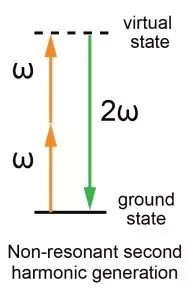
Second harmonic generation
When intense, coherent light illuminates certain materials, two incident photons can combine and re-emerge as a single photon at twice the original frequency — half the wavelength. Near-infrared light, for example, is converted into visible light. Because two photons become one, the process is intrinsically nonlinear: the wavelength of the light has changed during the interaction.
This conversion only proceeds under specific symmetry conditions. In a perfectly centrosymmetric environment, the contributions from neighbouring molecules cancel and no second-harmonic light is produced. Break that symmetry — at an interface, around a dipolar molecule, or at the surface of a particle — and the signal switches on.
Why symmetry carries the signal
Because SHS depends on the local breaking of centrosymmetry, the second-harmonic signal is a direct reporter of molecular organization. The intensity, polarization, and angular distribution of the scattered second-harmonic light all carry structural information that simply isn’t present in a linear optical measurement.
That sensitivity to symmetry is what makes SHS valuable: it does not require a large object to be present in order to produce a signal. A reorganization of molecules at the nanometer scale is enough.
Why it matters
Reading the earliest signatures of aggregation
Sensitivity to the molecular interface
When a compound is not fully dissolved, the first undissolved species create interfaces with the surrounding solvent. The solvent molecules reorient around these interfaces, breaking local symmetry. SHS reports on that reorganization with high sensitivity — long before there is any visible turbidity.
Onset, not just outcome
Because the SHS signal responds to the earliest stages of aggregation, it captures the onset of the process — the inflection point where a compound transitions from soluble to incipient aggregation. That is precisely the information that downstream assays react to, and exactly what conventional methods miss.
A label-free, in-solution readout
SHS requires no chromophore, fluorophore, or chemical modification. The measurement is made directly on the compound in its formulation buffer of choice, in standard microplate format, with minimal sample preparation.
Paired with LLS, by design
SHS is most powerful when read alongside Linear Light Scattering. SHS tells you when aggregation starts and when molecular reorganization at interfaces occurs; LLS tells you how it grows. The ORYL F1 collects both signals in the same measurement.
Within ULS
The two readouts of Ultrafast Light Scattering
Second Harmonic Scattering (SHS)
Nonlinear, symmetry-sensitive. Detects the molecular-scale onset of aggregation before particles are large enough to be seen by conventional light scattering.
Linear Light Scattering (LLS)
A well-established, broadly applicable particle-scattering readout. Tracks how aggregation evolves as particles grow large enough to scatter conventionally.
FAQ
Common questions about SHS
Second Harmonic Scattering (SHS) is a nonlinear optical technique. When intense, coherent light illuminates certain materials, two incident photons combine and re-emerge as a single photon at twice the original frequency. SHS exploits this to probe molecular organization with high sensitivity.
Second-harmonic generation only proceeds under specific symmetry conditions. In a perfectly centrosymmetric environment the signal cancels. Break that symmetry — at an interface, around a dipolar molecule, or at a particle surface — and the signal switches on. That makes SHS a direct reporter of molecular organization.
When a compound is not fully dissolved, the first undissolved species create interfaces with the surrounding solvent. Solvent molecules reorient around these interfaces, breaking local symmetry. SHS reports on that reorganization with high sensitivity, long before any visible turbidity appears.
Yes. Conventional light-scattering methods (DLS, SLS) and HPLC saturate or fail above approximately 5 to 10 mg/mL. Because SHS responds to molecular interfaces rather than to bulk scattering, it continues to deliver clean signals well above 50 mg/mL — making SHS the readout that enables the ORYL F1 to profile high-concentration biologic formulations where every other plate-based method falls short.
SHS captures the molecular-scale onset of aggregation and continues to deliver signal at high concentration where LLS saturates. LLS, with ORYL’s unique optical geometry, delivers sub-micromolar sensitivity at low concentration. Together they form the two complementary readouts of Ultrafast Light Scattering on the ORYL F1 — covering both ends of the concentration range that no single conventional method spans.
Scientific Publications & Posters
Explore peer-reviewed publications and conference posters on ULS and its applications.
Want to see SHS data from your own compounds?
Request a demo, send samples for a measurement service, or read the underlying science.