
A well-established optical readout that characterizes particles in suspension — paired with SHS on the ORYL F1 to follow aggregation from molecular onset through particle growth.
Technology · Readout
Linear Light Scattering
An introduction to LLS
Linear Light Scattering (LLS) is one of the two complementary readouts that make up Ultrafast Light Scattering (ULS) on the ORYL F1. It is the broadly applicable, classical side of the platform: when light interacts with particles in suspension, a fraction of that light is scattered, and the resulting signal carries information about particle population and size.
This page is a primer on what LLS measures, why it complements SHS, and how the two together resolve aggregation across its full timeline. For peer-reviewed detail, see the scientific publications.
The physics
One photon in, one photon out
A linear interaction
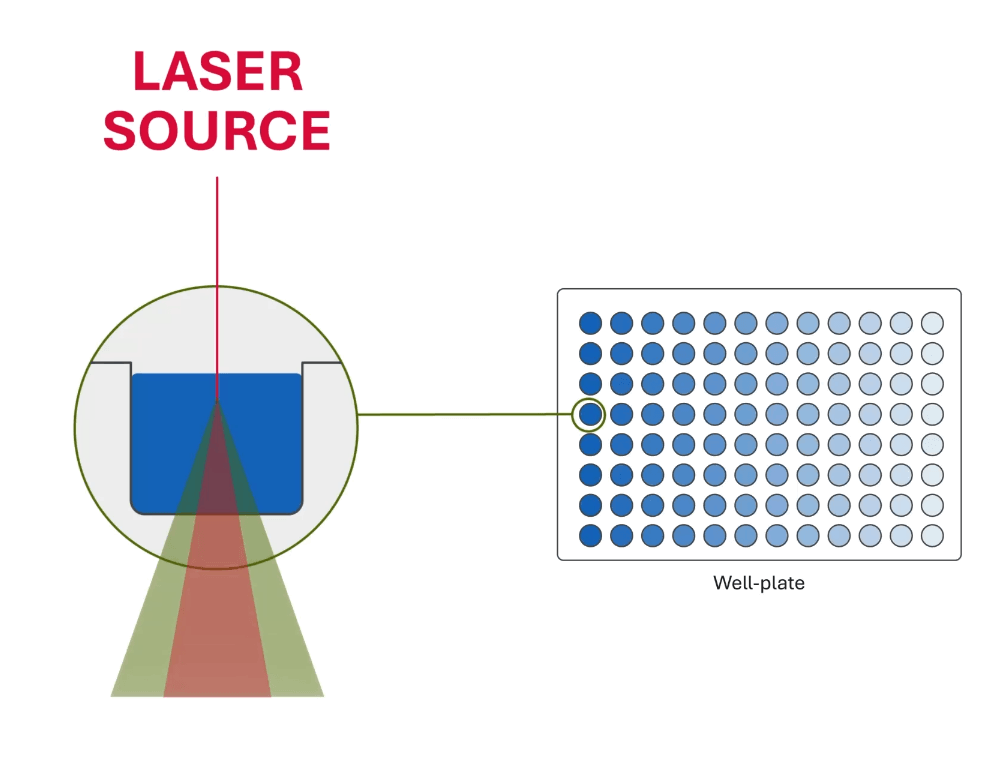
LLS is a linear optical process: an incident photon scatters off a particle and re-emerges at the same wavelength, with no change in frequency. There is no symmetry requirement on the scatterer — any particle whose refractive index differs from the surrounding medium will scatter light to some degree. That makes LLS broadly applicable across compound classes, formulations, and modalities.
The intensity of the scattered light is governed by well-understood physics, with established models describing how scattering scales with the size, concentration, and refractive index of the particles in solution.
What the signal reports
As aggregation proceeds, particles grow. Larger particles scatter more strongly, and the LLS signal rises accordingly. The measurement therefore acts as a quantitative reporter of how aggregation evolves over the course of an experiment — turning a static endpoint into a trajectory.
Because the underlying physics is shared with the techniques formulation and DMPK scientists already use, LLS results translate naturally into the language of existing solubility and particle-sizing workflows.
Why it matters
Tracking aggregation as it grows
Sensitivity beyond conventional DLS
ORYL F1’s LLS uses a unique optical geometry that achieves below 1 micromolar sensitivity — well beyond what conventional DLS or SLS deliver (typically 5 to 20 micromolar). The result: a reliable LLS readout for small molecules, PROTACs, and macrocycles at low concentrations where existing light-scattering methods cannot extract a signal.
Broadly applicable across modalities
Because LLS has no symmetry requirement and depends only on refractive-index contrast, it applies across small molecules, peptides, proteins, oligonucleotides, and complex modalities. Combined with the sensitivity advantage above, it becomes a robust workhorse readout for diverse pipelines — including the new modalities where classical LLS falls short.
Resolves the growth phase
Where SHS captures the molecular-scale onset of aggregation, LLS resolves what happens next. The combination separates compounds that show transient onset signals from those whose aggregation proceeds into measurable particle growth — a distinction that matters when ranking candidates.
Same measurement, same well
LLS is read in the same plate, on the same compound, at the same moment as SHS. No second instrument, no second sample preparation, no reconciliation between two datasets collected under different conditions.
Within ULS
The two readouts of Ultrafast Light Scattering
Second Harmonic Scattering (SHS)
Nonlinear, symmetry-sensitive. Detects the molecular-scale onset of aggregation before particles are large enough to be seen by conventional light scattering.
Linear Light Scattering (LLS)
A well-established, broadly applicable particle-scattering readout. Tracks how aggregation evolves as particles grow large enough to scatter conventionally.
FAQ
Common questions about LLS
Linear Light Scattering (LLS) is a well-established optical technique for characterizing particles in suspension. When laser light passes through a sample, particles scatter a fraction of that light; the intensity carries information about particle population and size.
LLS is a linear optical process — one incident photon scatters off a particle and re-emerges at the same wavelength, with no symmetry requirement. SHS is a nonlinear process that requires symmetry breaking. LLS captures particle growth; SHS captures the molecular-scale onset before particles are large enough to scatter conventionally.
SHS sees the onset of aggregation; LLS sees the growth. Run together in a single measurement, they resolve the full aggregation timeline — from molecular onset through particle growth — separating compounds that show transient onset events from those whose aggregation proceeds into measurable particle growth.
ORYL F1’s LLS uses a unique optical geometry that achieves below 1 micromolar sensitivity — well beyond conventional DLS or SLS, which typically resolve only 5 to 20 micromolar. This makes the LLS readout reliable for small molecules, PROTACs, and macrocycles at low concentrations where conventional light-scattering methods cannot extract a signal.
Scientific Publications & Posters
Explore peer-reviewed publications and conference posters on ULS and its applications.
Want to see LLS data from your own compounds?
Request a demo, send samples for a measurement service, or read the underlying science.