
Skip to main contentSkip to footer
Formulation

Excipient Screening

For Pre-formulation and Formulation teams running stabilizer screens

Screen surfactants, sugars, amino acids, salts, and buffers for small molecule and biologic stabilization at plate scale — matrix sizes traditional methods choke on.

What changes with the F1

Screens that scale with the matrix

Surfactants, sugars, amino acids, salts, buffers — full matrix in one plate run.

  • Surfactants, sugars, amino acids, salts, buffers — full matrix in one plate.
  • Simultaneous LLS aggregation + SHS state-change readout.
  • Cross-modality: small molecule and biologic, same workflow.
Excipient screening for biologic and small-molecule formulations icon
FAQ

Common questions about the Excipient Screening

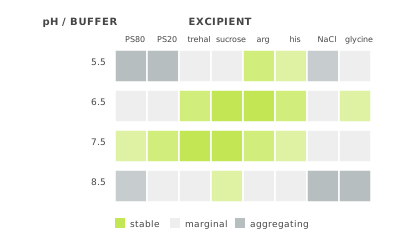
Dispense the excipient matrix — surfactants, sugars, amino acids, salts and buffers — into a 384-well plate and read solubility and aggregation directly on the ORYL F1 in about 15 minutes, ranking conditions by aggregation onset with no separation step — for example resolving how arginine, sucrose and salts shift the aggregation onset of a concentrated formulation.

Surfactants, sugars, amino acids, salts, buffers and biorelevant media across pH and concentration, for both small molecules and biologics, using about 2 microlitres of stock per datapoint.

It reads the formulation directly via LLS aggregation and SHS state-change without dilution or chromatography, so a full excipient matrix is profiled on one plate rather than across days of HPLC or DLS runs.

Ready to put the F1 to work on your samples?

De-risk solubility and aggregation in your pipeline — early, with low-compound, plate-based measurement.