Skip to main contentSkip to footer
Applications

Browse Our Applications

From early discovery screening to formulation profiling, the ORYL F1 delivers decision-ready solubility and aggregation results across a wide range of applications — explore to see how the ORYL F1 can support your workflow.
Filters
Tag
Reset
Established

Fully validated, customer-anchored use-cases where the ORYL F1 is already delivering value in pharma R&D pipelines — see Application Notes for details.

In Development

Applications within the ORYL F1’s capabilities that we are actively developing — reach out if you see a fit, we’re always open to new partnerships.

Formulation

Excipient Screening

Screen surfactants, sugars, amino acids, salts, and buffers for small molecule and biologic stabilization at plate scale — matrix sizes traditional methods choke on.

Formulation

High-Concentration Liquid Formulation

Aggregation propensity, viscosity proxies, and formulation ranking at concentrations where DLS saturates and B22 measurement is too slow to scale.

Formulation

Supersaturation Kinetics

Track precipitation kinetics from supersaturated states with fine temporal resolution. Lag phase, nucleation, growth — captured directly.

Discovery

Protein-Protein Interaction

Detect label-free protein-protein / protein-peptide assembly events (binding, conformational ordering, ternary PROTAC complexes) via SHS+LLS signatures.

Formulation

Vaccine Antigen Adsorption

Rank conditions for antigen-on-adjuvant adsorption efficiency, reading the adsorbed protein directly rather than inferring from supernatant depletion.

Formulation

Crystallization & Polymorph Screening

Non-centrosymmetric crystal lattices give a direct SHS signal (no transparency requirement on the matrix), LLS tracks crystal growth in parallel, and it works in opaque/turbid matrices where transmission-based optical methods struggle.

FAQ

Common questions about the Applications

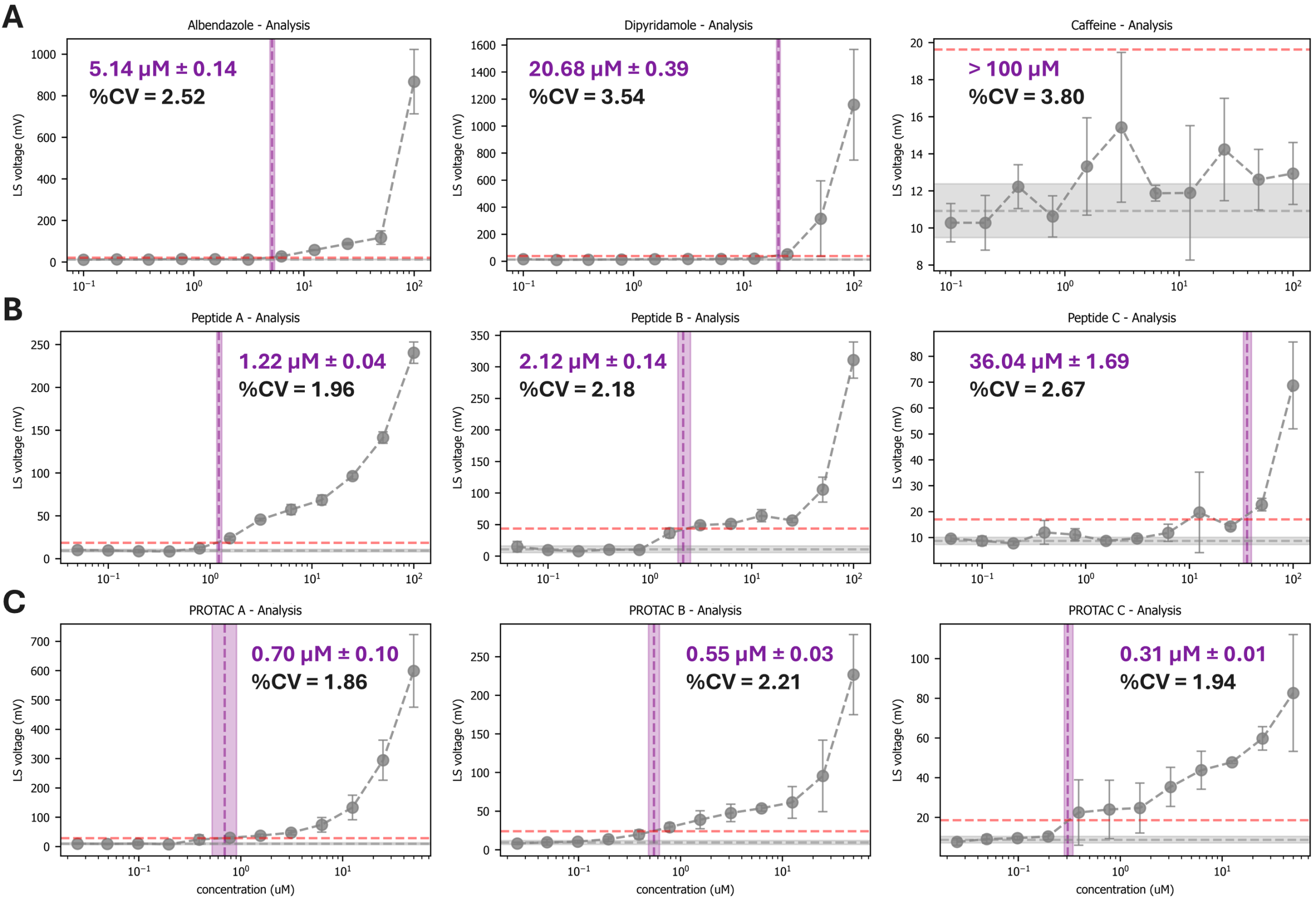
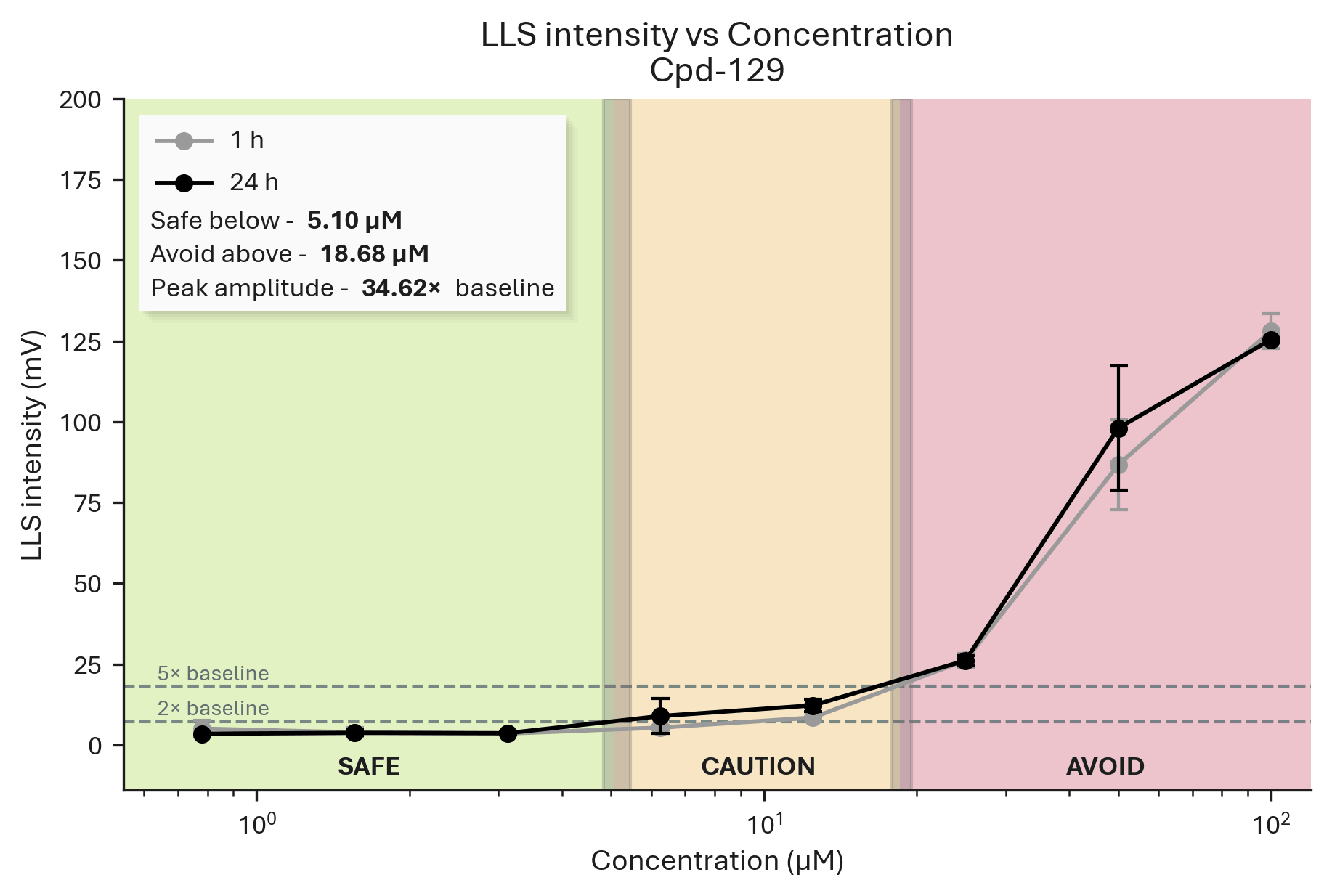
The ORYL F1 profiles solubility and aggregation across hundreds of conditions on a standard 384-well plate in approximately 15 minutes, using about 2 microlitres of 10 mM DMSO per datapoint with sub-1 micromolar sensitivity. It combines Second Harmonic Scattering (SHS) and Linear Light Scattering (LLS) to detect early-onset aggregation before turbidity, returning a per-compound solubility limit with confidence intervals and quality flags — and its SHS readout stays linear above 50 mg/mL, where DLS, SLS and nephelometry saturate.

From early discovery to formulation: compound triage before SPR, DMSO compound-stock QC, solubility and aggregation profiling of new modalities (small molecules, peptides, PROTACs, APIs), preformulation and excipient mapping, preclinical vehicle screening, and high-concentration biologic formulation (monoclonal antibodies, antibody-drug conjugates, oligonucleotides) above 50 mg/mL.

Yes — a high-throughput, low-compound alternative that runs before and alongside them, not a replacement. It profiles about 100x faster and with about 100x less compound than HPLC, and about 10x faster than DLS, SLS or nephelometry, and it keeps working above 50 mg/mL where DLS saturates above about 10 mg/mL.

Application Notes

Detailed application data and workflows are available in our resource library.

Have a specific application in mind?

Discuss your workflow with ORYL and see how the ORYL F1 can support your research.